 BACK TO FULL LIST OF PROJECTS
Introduction & Options
BACK TO FULL LIST OF PROJECTS
Introduction & Options
Tools & Materials
(this page)
 BACK TO FULL LIST OF PROJECTS
Introduction & Options
BACK TO FULL LIST OF PROJECTS
Introduction & Options
Tools & Materials
(this page)
The first page looked at the overall measurements of the gaff and possible profiles. Having obtained all the required measurements, this page looks at obtaining the raw materials and the tools required to construct the gaff.
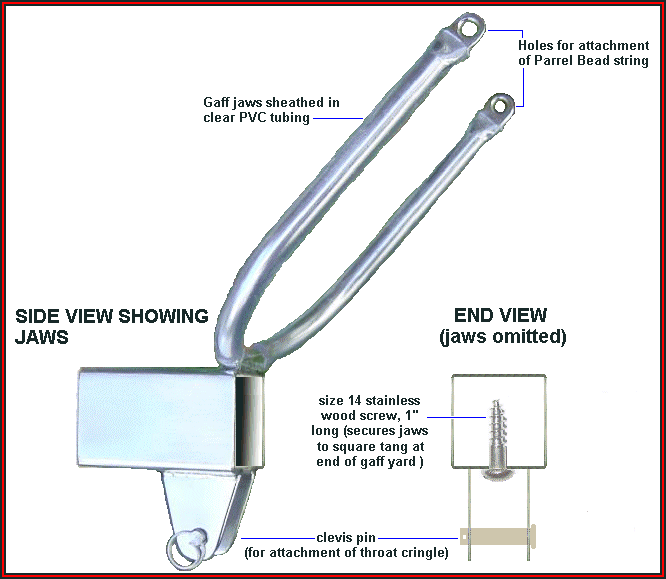
Originally on the first luggers, the jaws were constructed of wood. These were replaced by galvanised steel jaws and on currently produced boats, stainless steel jaws are used. The stainless steel jaws can be purchased from Churchouse Boats or Honnor Marine. I considered making wooden jaws but the steel ones are much more functional and also stronger than wood so steel was the final choice.
It is worth getting a quote from both suppliers. I paid a little over 65 UK pounds (April 2003), which included carriage. Also make sure that the jaws come with the essential extras;
Details of how the gaff is attached to the steel jaws will be covered after a description of the gaff construction.
Currently Drascombe spars are constructed by Collars using Sitka Spruce ( Picea sitchensis ) which takes its name from Sitka, the old Russian capital of Alaska on Baranof Island. The tree is also known as Silver Spruce.
John Watkinson's original timber specification for the Lugger spars was Douglas Fir ( Pseudotsuga menziesii ) named after the Scottish botanist, David Douglas, who introduced many of British Columbia's native conifers to Europe. The tree is also known as Columbian or Oregon Pine. Douglas Fir is stronger than Sitka Spruce and doesn't bruise so easily.
Either kind of wood can be used with apparently little difference in price. I decided to use Sitka Spruce as, at the time, I didn't realise that my existing spars were Douglas Fir! The quality and quantity required were specified as follows;
The 'Spar Grade' definition is vitally important as the wood must be of even grain and totally free of knots. The ordered length was slightly in excess of that actually required so that there was more than enough wood left over to make the wedges. There is little point in ordering planed timber as it is more expensive than sawn and in any case will be completely re-shaped during the making of the yard.
A specialist boat building timber supplier is essential. Robbins Timber had previously supplied some teak for replacing my centreplate capping. A visit to their website confirmed that they could supply Sitka Spruce or Douglas Fir in the small quantity that was required. Their quote for spar grade Sitka Spruce came to a total of 37.98 UK pounds (April 2003). This included tax and delivery.
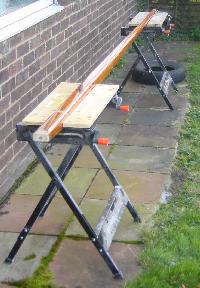
The first essential item is a system for supporting the spar whilst it is being planed and shaped.
Lee Gable at Collar's suggested the following tools:
I couldn't afford/obtain everything on Lee's list so pictured below are the tools which I had to hand and which were quite adequate for constructing the gaff.
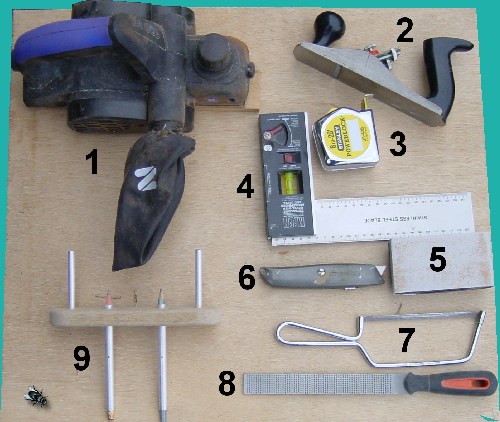
Tools used to make the Gaff. The numbers refer to the following list;
In addition to the illustrated items the following tools were also used;
Having obtained the wood & all the necessary tools, the next task was to commence marking out and construction of the gaff. This is described on the next page.
![[Back to page 1]](pics/leftarrow.gif "Back to page 1")
![[Forward to page 3, Making the Gaff]](pics/rightarrow.gif "Forward to page 3, Making the Gaff")